
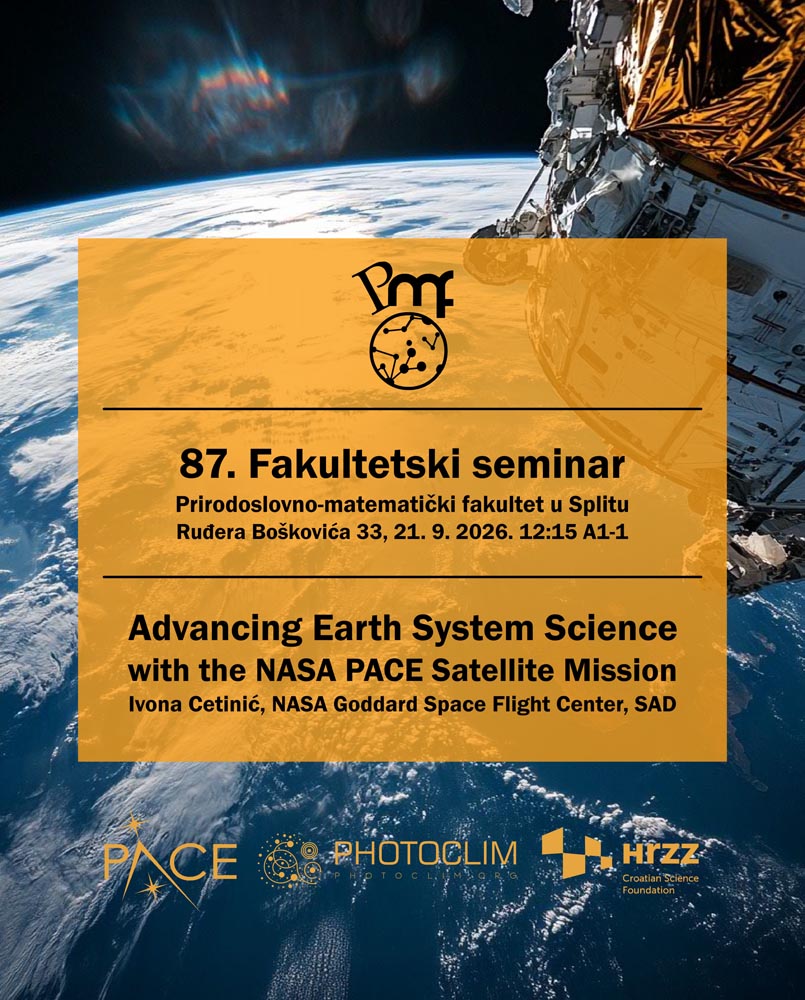
Zadovoljstvo nam je pozvati vas na 87. Fakultetski seminar 21. 9. 2026. u A1-1 u 12:15 na temu:
Advancing Earth System Science with the NASA PACE Satellite Mission
koji će održati prof. dr. sc. Ivona Cetinić s NASA Goddard Space Flight Center, SAD.
Niže kratki sažetak i životopis predavačice:
Sažetak
Launched in 2024, NASA’s Plankton, Aerosol, Cloud, ocean Ecosystem (PACE) mission represents a revolutionary leap forward in marine science. Building upon a multi-decadal heritage and by combining hyperspectral radiometry and multi-angle polarimetry, it brings unprecedented capabilities to Earth observation and establishes an entirely new paradigm for understanding our changing planet. At its core, PACE is a gamechanger for assessing ocean ecosystem health. By tracking aquatic phytoplankton, it provides the first daily, global measurements needed to predict fishery “boom-bust” cycles, trace harmful algal blooms, and monitor factors impacting marine industries. In doing so, PACE significantly enhances NASA’s 30-year ocean color data record, yielding crucial insights for studying our living oceans and answering emerging socioeconomic questions. While primarily an aquatic powerhouse, PACE also monitors the atmospheric and terrestrial systems that interact with our oceans. It tracks clouds and aerosols—information crucial for weather forecasts and air quality—and delivers near-daily, advanced views of land surfaces that extend historical vegetation records. As it passes its two-year anniversary, PACE delivers societal and earth research benefits unmatched by other current satellites. This presentation explores how the mission fills critical gaps in marine science, alongside its vital atmospheric and terrestrial contributions.
Kratki životopis
Ivona Cetinić is an oceanographer in the Ocean Ecology Laboratory at NASA Goddard Space Flight Center. Her research focuses on developing new ways of resolving ocean biogeochemistry and phytoplankton diversity from satellite and other remote observations. At the University of Southern California, she conceived of and participated in field campaigns focused on developing innovative ocean observing technology, several for which she served as chief scientist. These campaigns include the groundbreaking Tara Oceans circumnavigation of the globe, as well as others that utilized unique fusions of cutting-edge technology such as hyperspectral radiometry, light polarimeters, and airborne lidar, allowing for more detailed information about concentration and composition of particles in the ocean (as well as the atmosphere – SABOR and PACE-PAX). Dr. Cetinic has served as the project scientist for EXPORTS (EXport Processes in the Ocean from RemoTe Sensing), a large scale NASA-led field campaign, as the PACE (Plankton, Aerosol, Cloud, ocean Ecosystem) Project Science Lead for Ocean Biogeochemistry, a NASA mission that launched in 2024 and most recently, a deputy mission scientist for PACE-PAX validation campaign and PACE project science lead for PACE Validation and Science Team. In the last 10 years, she has been a member of multiple international science teams and committees and has served as the co-chair of the Ocean Optics Conference, and member of the National Academies of Sciences, Engineering, and Medicine Committee on Earth Sciences and Applications from Space. She earned her Ph.D. in biological oceanography at University of Southern California in 2009.