
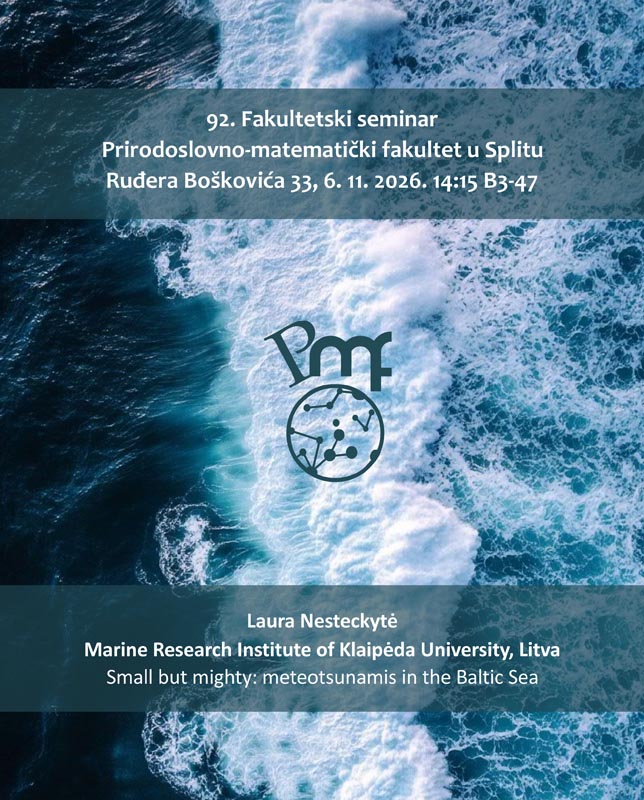
 Zadovoljstvo nam je pozvati vas na 92. Fakultetski seminar 6. 11. 2026. u B3-47 u 14:15 sa sljedećom temom:
Small but mighty: meteotsunamis in the Baltic Sea
koji će održati Laura Nesteckytė iz Marine Research Institute of Klaipėda University, Litva. Sažetak i kratki životopis predavačice se nalaze dolje, a u prilogu je plakat za društvene mreže.
Sažetak
Meteotsunamis are long-period sea level oscillations generated by fast-moving atmospheric disturbances, such as convective clouds and pressure jumps, and amplified through Proudman and harbour resonance. Baltic meteotsunamis are modest compared with the well-known Adriatic events, but they still close ports, damage vessels and push saline water into the Curonian Lagoon. This seminar presents research on meteotsunamis in the southeastern Baltic Sea, focusing on the Port of Klaipėda and combining tide-gauge and meteorological records, weather-radar data and high-resolution numerical modelling. Between 2017 and 2023, the Klaipėda tide gauge recorded about 16 meteotsunami-like oscillations per year, with typical amplitudes of 10–30 cm. The port–strait system has stable natural periods of about 14 and 26 minutes, so incoming long-period oscillations tend to be amplified inside the harbour: relatively small meteotsunamis can grow considerably and then turn into harbour seiches, which can be even more dangerous for port operations. Which leads to a question shared by the Baltic and the Adriatic: if we can watch the storm approaching, how close are we to predicting the meteotsunami it brings?
Kratki životopis
Dr. Laura Nesteckytė is a researcher at the Marine Research Institute of Klaipėda University, Lithuania, working on meteotsunamis, long-period sea level oscillations and related marine hazards. She received her PhD in physical geography from Klaipėda University in 2026. Alongside her studies, she spent eight years at the Lithuanian Hydrometeorological Service working in aeronautical meteorology, aviation safety and marine forecasting. In 2024–2025, with support from the Baltic-American Freedom Foundation, she spent a year at NOAA’s Pacific Marine Environmental Laboratory in Seattle, adapting tsunami-forecasting methods to meteotsunamis. Her current research combines weather-radar observations with high-resolution hydrodynamic modelling to improve meteotsunami forecasting.